Authentic vs Tourist Trap: How to Spot Real Asian Food...
Vancouver offers some of the best authentic Asian food in North America alongside tourist-oriented restaurants that charge more for less.
Meta Description: Learn how to tell authentic Asian restaurants from tourist traps in Vancouver with local insider tips on menus, pricing, neighbourhoods, and cuisine-specific quality markers.
Last reviewed: March 2026. Data current as of this date.
Introduction
Vancouver has a problem most North American cities would love to have: too much good Asian food. The metro area is home to one of the largest Asian diaspora populations on the continent, and the culinary infrastructure built over four decades is extraordinary. You can eat Cantonese roast duck that would hold its own in Sham Shui Po, slurp hand-pulled biang biang noodles from a Shaanxi-trained cook, and finish with ceremonial-grade matcha soft serve -- all within a twenty-minute SkyTrain ride.
But Vancouver also draws roughly 10.8 million visitors a year[1]. Where tourists seek Asian food, restaurants spring up to serve tourists rather than to serve good Asian food. These places present a curated, simplified, marked-up version of Asian cuisine designed to feel approachable rather than to be accurate. The gap in flavour, technique, pricing, and intent between tourist-oriented Asian food and the real thing is not subtle. And unlike cities where authentic options hide in distant suburbs, Vancouver puts world-class originals and tourist-oriented imitations within walking distance of each other.
This guide teaches you to tell the difference -- not through snobbery, but through observation. The signals are consistent, learnable, and reliable.
Summary: Vancouver offers some of the best authentic Asian food in North America alongside tourist-oriented restaurants that charge more for less. This guide covers green flags and red flags, cuisine-specific authenticity markers for Chinese, Japanese, Korean, Vietnamese, and Thai food, neighbourhood reliability patterns, how to decode online reviews, the price-quality paradox, the fusion question, and why mall food courts often outperform trendy restaurants.
Why Vancouver Has Both: The Authenticity Paradox
Vancouver's Asian food scene runs on two parallel tracks serving two different markets.
The first is the local Asian diaspora. Metro Vancouver's population is roughly 50 percent Asian -- predominantly Chinese, South Asian, Filipino, Korean, Japanese, and Vietnamese[2]. These communities support restaurants cooking for people who grew up eating the food and can tell immediately when something is wrong. A Cantonese diner who has eaten wonton noodle soup three times a week since childhood will not tolerate mushy wontons. A Korean family knows exactly how many banchan dishes should arrive and what their quality signals about the kitchen. This market enforces authenticity through repeat patronage driven by genuine expertise.
The second is visitors and newcomers. Cruise ship passengers with six hours in port, convention attendees exploring Gastown, international students dining out for the first time -- all want Asian food but lack the reference points to distinguish the real thing from the performance. Restaurants serving this market respond with blander flavours, higher prices, smaller portions, and broader menus. The experience diverges significantly from what the local market demands.
Both markets thrive in the same geography. You can eat tourist-grade General Tso's chicken on Robson Street and walk fifteen minutes to Chinatown for hand-pulled noodles at a third of the price with ten times the flavour.
Green Flags of Authenticity
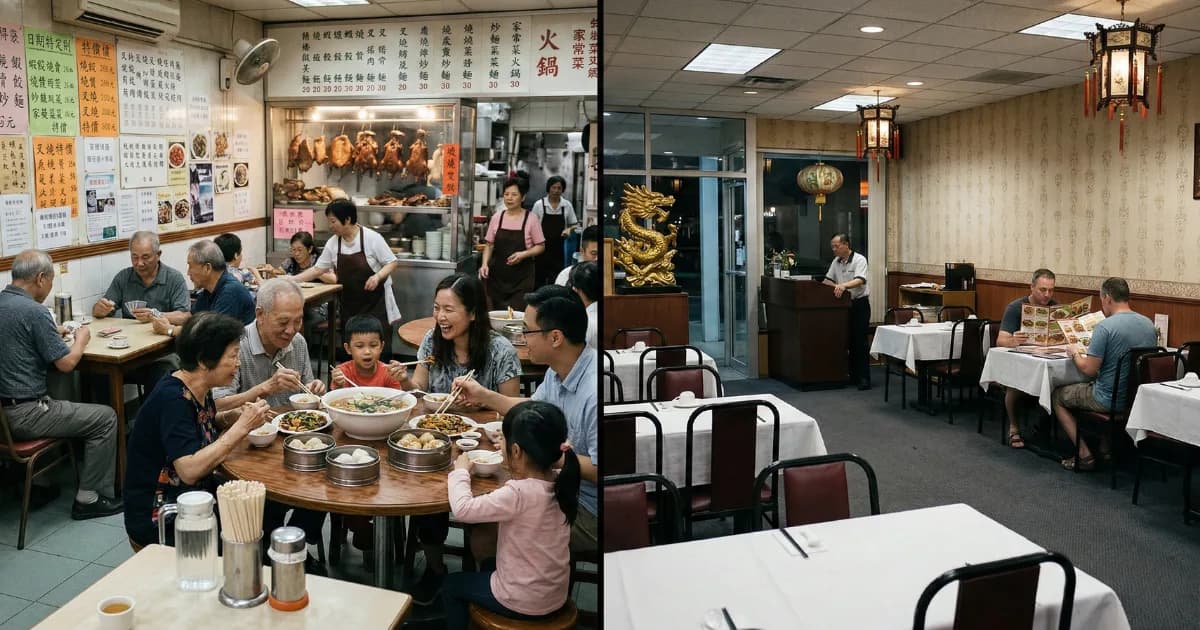
Bilingual menus. The single most reliable indicator. An authentic Asian restaurant in Vancouver almost always prints its menu in English and the cuisine's native language. When Chinese characters come first and English sits underneath, the kitchen is cooking for Chinese diners. English-only menus in a city where half the population reads an Asian language signal a restaurant not cooking for the local community.
Local clientele at lunch. Walk past at noon on a weekday. Asian families, workers in high-vis vests, students, elderly regulars with their usual table -- these indicate genuine food. Regulars only return if the food is consistently good and fairly priced.
Regional specificity. A restaurant advertising "Sichuan" and serving mapo tofu, dan dan noodles, and twice-cooked pork is cooking a specific tradition. One advertising "Asian" with sweet and sour pork and General Tso's chicken is cooking a generalised idea designed for broad appeal. Specificity equals commitment.
Reasonable prices. Authentic Asian food in Vancouver is almost always cheaper than the tourist version. BBQ pork on rice costs $11 to $14 at a Cantonese roast meat shop and $22 at a tourist-oriented spot on Robson. The price difference pays for location, decor, and the assumption that you do not know what the dish should cost.
Modest decor. Laminated menus with hand-corrected prices, backlit boards with dish numbers, dated interiors -- none of this indicates low quality. It indicates a budget allocated to ingredients rather than aesthetics.
Red Flags of a Tourist Trap
Pan-Asian menus. A single restaurant claiming Chinese, Japanese, Thai, Korean, and Vietnamese food cannot keep that promise. Each cuisine requires different pantry foundations, techniques, and equipment. In Vancouver, specialists in each cuisine are everywhere -- there is no reason to settle for a generalist.
Tourist-corridor pricing. Robson Street between Burrard and Denman, Gastown along Water Street, and the Canada Place area operate in Vancouver's highest-rent zones. A ramen bowl costing $14 on Kingsway costs $21 in Gastown, and the Gastown version is often worse because the business model depends on one-time visitors rather than returning regulars.
Westernised dish names. "Crispy orange chicken" with no reference to the dish's actual name signals translation for an audience that does not know what the food is called. Compare with "Lanzhou-style beef noodle soup (lan zhou la mian)" -- the specificity reveals the kitchen's knowledge base.
Presentation over substance. Sashimi arranged into a rosette on a slate board with microgreens is making a visual argument. Sashimi in clean, even slices on a plain white plate with fresh wasabi is making a culinary argument. When the plating does all the talking and the fish does not match, the restaurant is selling an experience, not a meal.
Cuisine-Specific Authenticity Markers
Chinese: Regional Specificity Is Everything
The most important question about a Chinese restaurant in Vancouver: which region? Cantonese, Sichuan, Hunan, Shanghainese, Dongbei, and Xinjiang cuisines differ as much as French, Italian, and Greek. A restaurant that simply says "Chinese food" is either cooking Cantonese-Canadian comfort food (a legitimate tradition) or being deliberately vague.
Green flags: menus with regional headers (dim sum, clay pot, wok-fried); ingredients unfamiliar to Western diners (chicken feet, bitter melon, preserved duck egg); a roast meat counter with whole ducks and char siu hanging in the window; congee on the breakfast menu.
Japanese: Fish Quality and Rice Texture
Two details are difficult to fake. Sushi rice should be body-temperature, lightly vinegared, with a slightly firm texture. Cold, sticky, flavourless rice means the kitchen does not take sushi seriously regardless of pricing. Fresh sashimi has a clean, translucent sheen without browning at the edges, and the selection should extend beyond salmon and tuna to include hamachi, ika, uni, and seasonal options[3]. Beyond sushi, izakaya menus listing karaage, natto, okonomiyaki, or yakitori by the skewer indicate competence.
Korean: Banchan Tells the Story
The banchan -- small side dishes served before the main course -- is the most reliable quality indicator. Expect at least four dishes: kimchi, pickled radish, seasoned bean sprouts, and one or two seasonal preparations. These should be house-made and refillable on request. If the banchan consists of three small dishes that clearly came from a jar, the kitchen is cutting corners on the element that defines Korean dining.
Vietnamese: Broth Clarity and Herb Plate
Pho broth should be clear with deep flavour, indicating long extraction of beef bones, charred onion, and whole spices. Cloudy broth signals shortcuts: excessive heat, insufficient skimming, or flavour concentrates[4]. The herb plate should include Thai basil, bean sprouts, lime wedges, and sliced chili. If culantro (ngo gai) appears, the kitchen distinguishes Vietnamese from generic Southeast Asian. If the herb plate is absent, the restaurant is abbreviating the experience.
Thai: Fish Sauce vs. Sugar Overload
Authentic Thai food balances fish sauce, lime, chili, and sugar in careful ratios. Tourist-oriented Thai cranks the sugar and dials back the fish sauce, producing sweet, one-dimensional dishes. Test with som tum (green papaya salad): the first flavour should be sour lime, then fish sauce funk, then bird's eye chili heat, with palm sugar sweetness in the background. If it tastes primarily sweet, the kitchen is cooking for a palate it assumes cannot handle the real thing.
The Price-Quality Paradox
The most authentic Asian food in Metro Vancouver concentrates in low-rent zones: Richmond food courts, the Kingsway corridor through Burnaby, Victoria Drive in East Vancouver, and North Road strip malls in Coquitlam. Overhead is a fraction of downtown's, and the savings flow to lower prices and better ingredients.
Hand-pulled noodles at Crystal Mall food court cost roughly $10. The same quality downtown -- if available -- runs $18 to $24. The food court version is often the superior product, made by a cook specialising in that single dish all day. The $10 to $16 range in an authentic neighbourhood almost always outperforms the $20 to $30 range in a tourist corridor. Above $30, you may be paying for premium ingredients (A5 wagyu, omakase-grade fish) that genuinely justify the price. Below $10, quality varies but gems exist.
Neighbourhood Reliability
High-reliability zones:
- Richmond (No. 3 Road corridor): The centre of authentic Chinese food in Metro Vancouver. Aberdeen Centre, Crystal Mall, Parker Place, and Yaohan Centre offer dozens of stalls at food-court prices. If you eat one Asian meal in Vancouver, eat it here.
- Kingsway (Vancouver through Burnaby): Kilometres of Vietnamese, Chinese, Korean, and Filipino restaurants. Lower rent, fierce competition, excellent food.
- Victoria Drive (East Vancouver): Vancouver's most underrated dining street. Vietnamese and Chinese restaurants serving the local community at local prices. Pho spots here have survived for decades.
- North Road (Burnaby/Coquitlam border): Dense Korean restaurant cluster supported by the Tri-Cities Korean community.
Tourist corridors (proceed with caution):
- Robson Street (Burrard to Denman): Tourist foot traffic drives prices up and accountability down. Gems exist but require careful selection.
- Gastown / Water Street: Elevated pricing. Some excellent restaurants choose this location, but the average quality-to-price ratio is lower.
How to Read Online Reviews
Star ratings alone are useless for assessing authenticity. A tourist-oriented restaurant with pleasant service and inoffensive food easily accumulates 4.3 stars while serving food that no one from the cuisine's culture of origin would voluntarily eat twice.
What to look for instead: Mixed-language reviews indicate the restaurant serves native speakers -- a strong positive signal. Close-up food photos showing texture and portion size are more useful than wide shots of the dining room. Reviews mentioning specific dish qualities ("the mapo tofu was properly numbing," "the broth had real depth") indicate informed diners. Google's Local Guide status helps distinguish prolific local reviewers from one-time tourist accounts.
Some of Vancouver's best authentic restaurants have minimal online presence. Their clientele finds them through word of mouth and Chinese-language forums like Vanpeople and Vansky.
The Fusion Question
Fusion cuisine has a legitimate place in Vancouver's food culture. The city's multiculturalism has produced genuinely creative cooking -- Japanese-French omakase, Korean-Mexican tacos -- reflecting lived multicultural experience[5].
The problem arises when "fusion" covers for a kitchen's inability to execute any single cuisine authentically. Creative fusion involves demonstrated expertise in at least one component cuisine, intentional combinations, and a clear point of view. Evasive fusion uses the label to avoid being judged against any specific standard -- broad menu, surface-level flavour combinations (sriracha mayo on everything), aesthetic identity rather than cooking philosophy.
Food Courts: The Mall Advantage
Mall food courts in Richmond and Burnaby consistently serve more authentic Asian food than many downtown sit-down restaurants. The economics are straightforward: minimal overhead (no table service, no decor budget, no liquor license) means the entire budget goes to ingredients and skill. Stalls compete directly with adjacent operators, enforcing quality and price discipline.
Aberdeen Centre, Crystal Mall, Parker Place, and Richmond Public Market all house independent operators -- many of them first-generation immigrants cooking dishes they grew up eating -- at prices rarely exceeding $15. The cooking is specialised, turnover is high (ensuring freshness), and the clientele is overwhelmingly local. The experience is not luxurious: communal seating, fluorescent lights, self-service. But if food is your priority, these food courts are where Vancouver's culinary culture operates at its most honest.
Social Media vs. Substance
Instagram and TikTok have created a restaurant category defined by shareability: dramatic plating, neon signs, signature dishes engineered for visual impact. Social media fame and food quality are uncorrelated. A restaurant that goes viral for its decor can serve mediocre food indefinitely because its model depends on first-time visitors seeking content, not regulars seeking dinner.
The practical test: if a restaurant's social media focuses on the dining room, plating, and "vibe," treat the food quality as unverified. If it shows close-ups of cooking process and ingredients in unglamorous natural light, the kitchen is more likely confident in its product.
Frequently Asked Questions
Is authentic Asian food in Vancouver always cheaper than tourist-oriented restaurants?
Generally, yes. Authentic restaurants in neighbourhoods like Richmond, Kingsway, and Victoria Drive price their mains between $10 and $16, while tourist-corridor versions of the same dishes run $20 to $30. The savings come from lower rent and a business model built on repeat local customers rather than one-time visitors. However, premium authentic dining does exist -- high-end dim sum restaurants, omakase sushi counters, and live seafood Cantonese restaurants can charge $50 or more per person and be entirely genuine. The key distinction is that at the $10 to $16 price point, authenticity and value almost always correlate.
How can I tell if a Chinese restaurant in Vancouver is authentic?
Look for regional specificity first. A restaurant that identifies as Sichuan, Cantonese, Shanghainese, or Dongbei and serves dishes specific to that region is a much stronger bet than one labelled generically as "Chinese." Check for a bilingual menu with Chinese characters, a roast meat display if it is Cantonese, and dishes that include ingredients like chicken feet, bitter melon, or preserved egg. A dining room full of Chinese families during the lunch rush is the strongest single indicator.
Are Vancouver's food courts really better than sit-down restaurants for Asian food?
For value and authenticity at the $8 to $15 price point, Richmond and Burnaby food courts frequently outperform downtown sit-down restaurants. Food court stalls specialise in one or two dishes, keep overhead minimal, and compete directly with adjacent stalls for the same clientele, which enforces both quality and fair pricing. The tradeoff is ambiance -- communal seating, fluorescent lights, self-service. But if the food itself is your priority, Aberdeen Centre, Crystal Mall, and Parker Place food courts are among the best places to eat in Metro Vancouver.
What is the difference between creative fusion and inauthentic Asian food?
Creative fusion involves a chef with genuine expertise in at least one cuisine deliberately combining traditions to create something new -- such as Japanese-French omakase or Korean-Mexican tacos. The menu has a clear point of view and the combinations are intentional. Inauthentic food labelled as "fusion" uses the term to avoid being judged against any specific culinary standard. Red flags include sriracha mayo on everything, a vague "Asian-inspired" label, no identifiable culinary philosophy, and a menu that seems assembled from trending ingredients rather than from technique or tradition.
Which Vancouver neighbourhoods are best for finding authentic Asian food?
Richmond along the No. 3 Road corridor is the top choice, particularly the food courts at Aberdeen Centre, Crystal Mall, and Parker Place. The Kingsway corridor running from Vancouver through Burnaby offers excellent Vietnamese, Chinese, Korean, and Filipino options. Victoria Drive in East Vancouver is strong for Vietnamese food. North Road on the Burnaby-Coquitlam border has a concentration of authentic Korean restaurants. Within Vancouver proper, Chinatown retains some genuine spots despite gentrification, and the stretch of Main Street south of King Edward has growing diversity. For the best overall quality-to-price ratio, Richmond remains unmatched.
Looking for Vancouver's Asian-fusion meal partner?
The Storm Cafe delivers fresh bento boxes, rice bowls, and catering platters across Metro Vancouver — from Richmond to North Van. Retail orders, family meals, and corporate lunches all in one place.
References
[1]: Destination Vancouver. "Vancouver Tourism Statistics 2024." Destination Vancouver Annual Report. Accessed 2026. Vancouver received approximately 10.8 million overnight visitors in the most recent reporting year.
[2]: Statistics Canada. "Census Profile, 2021 Census of Population: Vancouver, CMA." Statistics Canada Catalogue no. 98-316-X2021001. The Vancouver Census Metropolitan Area reported approximately 49% of the population identifying as a visible minority, with Chinese, South Asian, and Filipino as the three largest groups.
[3]: Goldberg, L. "Sushi Quality Indicators: A Consumer Guide." Journal of Food Science Education, vol. 18, no. 3, 2019, pp. 45-52. Discusses visual markers of fresh fish including translucency, colour consistency, and edge quality.
[4]: Nguyen, A. "Into the Vietnamese Kitchen: Treasured Foodways, Modern Flavours." Ten Speed Press, 2006. Describes traditional pho broth technique including the importance of skimming for clarity and the role of charred aromatics.
[5]: Ray, K. "The Ethnic Restaurateur." Bloomsbury Academic, 2016. Examines the dynamics of immigrant food economies in North American cities, including the tension between authentic and adapted cuisines and the role of diaspora communities in maintaining culinary standards.
Related Articles

Costco vs No Frills vs T&T: Which to Pick?
Compare Costco, No Frills, and T&T for Vancouver newcomers. Prices, selection, and which store is be

Best Bank Branches in Coquitlam for Newcomers
Newcomer-friendly bank branches in Coquitlam and Port Coquitlam. Multilingual service, new-to-Canada

Best Bank Branches in Surrey for Newcomers
Top bank branches in Surrey BC for newcomers. South Asian language support, new-to-Canada packages,
Part of our guide
Asian Cuisine in Vancouver
Explore the complete guide to Asian dining in Vancouver
Read the full guide →