Low-Sodium Asian Meals in Vancouver: A Heart-Healthy Guide
Find low-sodium Asian meals in Vancouver. Learn sodium levels in popular dishes, how to order heart-healthy at Chinese, Japanese, Korean, Vietnamese and Thai restaurants, plus cooking tips.
Asian food in Vancouver is extraordinary. Walk along Alexandra Road in Richmond, duck into any ramen joint on Robson, or hit a Korean BBQ spot in Burnaby, and you'll find flavors that are layered, complex, and deeply satisfying. But if you're watching your sodium intake — because your doctor told you to, because you've got a family history of hypertension, or because you've simply read the research — navigating Asian restaurants can feel daunting.
The challenge isn't that Asian cuisine is inherently unhealthy. It isn't. The challenge is that many foundational flavor builders — soy sauce, fish sauce, oyster sauce, fermented bean pastes — are sodium-dense by nature. A single tablespoon of regular soy sauce packs roughly 900mg of sodium, nearly 40% of Health Canada's recommended daily limit of 2,300mg[1]. When a dish uses soy sauce and oyster sauce and a splash of fish sauce, you can blow past your daily target in a single bowl.
But Asian cuisine also gives you powerful tools for building flavor without sodium: charring, toasting spices, using acid, layering aromatics, and harnessing natural umami from mushrooms and seaweed. This guide breaks down what to order, what to avoid, and how to eat heart-healthy at Asian restaurants across Vancouver.
Summary: Asian cuisine relies heavily on sodium-rich condiments like soy sauce (900mg per tablespoon) and fish sauce, but also offers powerful low-sodium flavor tools including aromatics, acid, and natural umami. This guide covers sodium levels in popular dishes, restaurant-by-restaurant ordering strategies across Chinese, Japanese, Korean, Vietnamese, and Thai cuisines in Vancouver, plus cooking techniques and ingredient swaps that reduce sodium without sacrificing taste.
The Sodium Problem in Numbers
Health Canada recommends adults consume no more than 2,300mg of sodium per day, with an adequate intake of 1,500mg[1]. The average Canadian actually consumes about 2,760mg daily[2]. For Asian-Canadians in BC, the numbers may be even higher — dietary patterns heavy in soy-based condiments and fermented foods are associated with elevated sodium intake among East Asian immigrant communities[3].
Cardiovascular disease accounts for approximately 27% of all deaths in British Columbia[8]. Hypertension — directly linked to excessive sodium — affects roughly one in four Canadian adults[4]. For many families in Metro Vancouver, Asian food isn't an occasional restaurant choice — it's every meal, every day. Understanding sodium content is essential.
Here's what common Asian restaurant dishes actually contain:
A single bowl of miso ramen can contain more sodium than your entire daily allotment. But sashimi, fresh spring rolls, clear-broth tom yum, and steamed fish with ginger all come in well under 1,000mg. Low-sodium eating at Asian restaurants isn't about deprivation — it's about knowing which dishes are naturally lower and which ones are sodium traps.
Why Asian Cooking Relies on Sodium
Understanding the why helps you eat smarter.
Soy sauce is the backbone of Chinese, Japanese, and Korean cooking — fermented soybeans with salt that produce an intense concentration of glutamates (umami). Regular soy sauce contains approximately 900-1,000mg of sodium per tablespoon[5]. Fish sauce, made from salted fermented anchovies, delivers roughly 1,400mg per tablespoon[5] and underpins Vietnamese and Thai cooking. Fermented pastes — doenjang, miso, doubanjiang — add depth and complexity but are concentrated salt sources.
MSG gets an unfair reputation. It contains about one-third the sodium of table salt, and because it amplifies flavor effectively, it can be used in smaller quantities. The problem is that MSG is often added on top of soy sauce, not instead of it[6]. Oyster sauce, hoisin, and black bean sauce each contribute additional sodium. When a Cantonese stir-fry calls for soy sauce, oyster sauce, and sugar to balance — a classic technique — you're stacking sodium sources.
Many traditional Asian dishes were developed when salt was a preservative, fermentation agent, and flavor enhancer simultaneously. These are functional recipes — but they weren't designed for sedentary modern lifestyles where cardiovascular disease is a leading killer.
Naturally Low-Sodium Dishes Worth Seeking Out
Every Asian cuisine has dishes that are naturally lower in sodium. These are mainstream items — no special ordering required.
Japanese: Sashimi (you control the soy sauce dip), unsalted edamame, grilled fish with light seasoning, and chawanmushi (steamed egg custard).
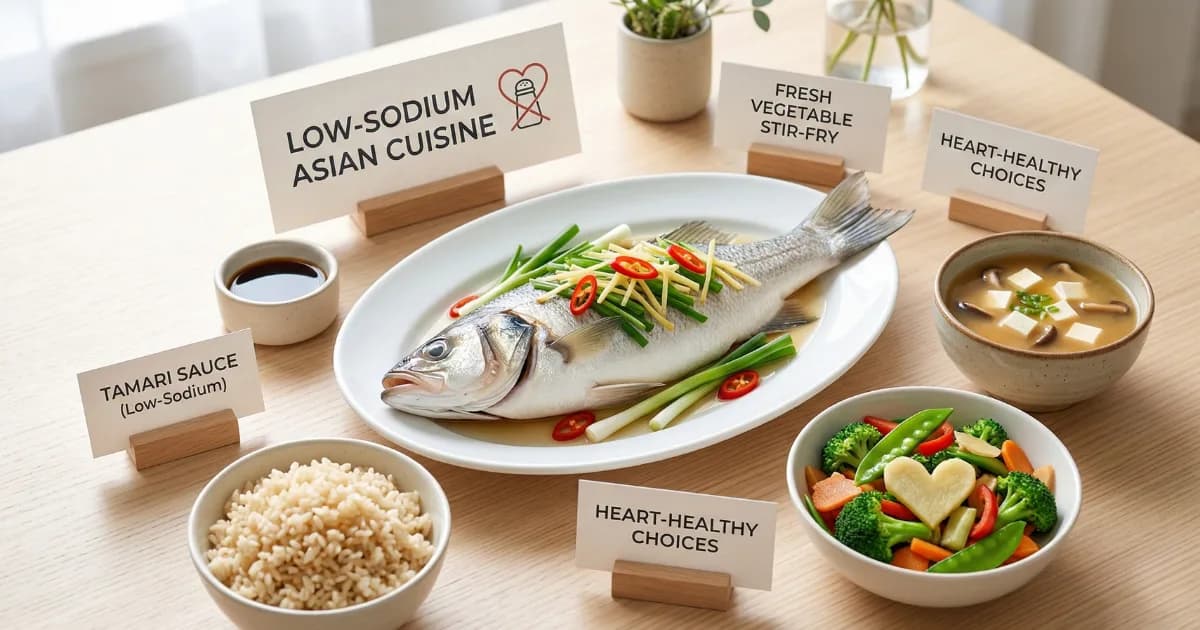
Chinese: Steamed fish with ginger and scallion (one of Cantonese cooking's crown jewels — minimal soy sauce), clear soups with winter melon or watercress, stir-fried vegetables with garlic (sauce on the side), and plain congee with toppings you add yourself.
Korean: Bibimbap with gochujang on the side (the paste is where sodium concentrates), grilled bulgogi with lighter marinade, and japchae (sweet potato glass noodles with sesame oil — lighter on soy sauce than most Korean dishes).
Vietnamese: Fresh spring rolls (the roll itself is nearly sodium-free — go easy on dipping sauce), broken rice with grilled meats (skip the fish sauce on the table), and bun cha (dipping rather than swimming controls sodium exposure).
Thai: Tom yum in clear broth (lemongrass, galangal, and chili do the heavy lifting), papaya salad with less fish sauce, and grilled meat skewers like moo ping (sodium lives in the dipping sauce, which you control).
How to Order Low-Sodium at Vancouver Restaurants
Six strategies that work across all Asian cuisines:
Ask for sauce on the side. The single most impactful change. Most Vancouver restaurants, especially in Richmond and along Kingsway, are accustomed to this request.
Request less soy sauce or less salt. Works better at smaller, cook-to-order places than large operations with pre-made sauce batches.
Choose steamed, grilled, or raw over braised, fried, or sauced. Cooking method is a reliable proxy for sodium content.
Skip the soup broth or drink sparingly. In pho, ramen, and wonton soup, the broth is the sodium reservoir. Eating noodles and toppings while treating broth as a condiment can cut sodium by 40-50%.
Watch the condiment table. Soy sauce, chili oil, hoisin, fish sauce — using them reflexively before tasting is one of the easiest ways to add 500-1,000mg of sodium unknowingly.
Ask about MSG usage. Not because it's dangerous, but knowing helps you estimate total sodium.
Vancouver-specific tips:
At Chinese restaurants in Richmond, dim sum steamed items (har gow, cheung fun) are lower-sodium than fried options — but ask for soy sauce on the side for cheung fun. At Japanese restaurants on Robson, sushi is far lower than ramen; if you want ramen, ask for lighter broth. At Korean spots in Burnaby and Coquitlam, enjoy banchan in small portions — kimchi and pickled vegetables are sodium-significant. At Vietnamese restaurants on Kingsway, skip the hoisin and sriracha on the table; let the broth stand on its own. At Thai restaurants, order curry with extra vegetables to dilute sodium per bite, and eat with plain steamed rice.
Cooking Low-Sodium at Home
Vancouver's Asian grocery stores — T&T, H-Mart, Fujiya, Kim's Mart — make home cooking the best path to sodium control. Here are techniques that build deep flavor with less salt:
Char and sear aggressively. High-heat wok cooking produces Maillard browning that creates savory complexity independent of salt. A well-charred chicken thigh needs less soy sauce to taste satisfying.
Toast spices and layer aromatics. Dry-toasting Sichuan peppercorns, cumin, and dried chili releases volatile oils. Combining four or five aromatics — ginger, garlic, lemongrass, galangal, scallion — in a single dish lets aromatic complexity do the flavor heavy lifting.
Use acid liberally. Lime juice, rice vinegar, tamarind, and black vinegar create brightness that makes food taste fully seasoned even with less salt. Vietnamese cuisine does this naturally with herb plates and lime wedges.
Harness umami beyond soy sauce. This is the key insight. The umami flavor that makes soy sauce indispensable exists in many low-sodium ingredients. Umami compounds (glutamate, inosinate, guanylate) have a synergistic effect — combining two umami-rich ingredients produces flavor greater than the sum of parts[6]:
| Combination | Use | Why It Works |
|---|---|---|
| Dried shiitake + kombu broth | Soup base, braising liquid | Glutamate + guanylate synergy |
| Tomato + mushroom stir-fry | Vegetable dishes | Double glutamate |
| Miso (small amount) + roasted sesame | Dressing, marinade | Fermented glutamate + nutty depth |
| Fermented black garlic + ginger | Sauce, glaze | Concentrated glutamate + aromatics |
If your low-sodium dish tastes flat, the answer usually isn't more salt — it's more umami from a non-sodium source.
Low-Sodium Soy Sauce Alternatives
Reduced-sodium soy sauce cuts sodium by 25-40% (roughly 550-600mg per tablespoon instead of 900-1,000mg)[5]. Available at any Vancouver grocery store — the easiest one-for-one swap.
Tamari (Japanese-style, often wheat-free) in its reduced-sodium form offers richer flavor, meaning you can use less.
Coconut aminos is the lowest-sodium option — roughly 90-130mg per tablespoon[7]. Made from fermented coconut sap, it's sweeter and milder. It won't replicate a soy-heavy braise, but it works beautifully in dipping sauces and dressings. Available at Whole Foods on Cambie, Choices Markets, and most health food stores across Metro Vancouver.
A practical approach: reduced-sodium soy sauce as your everyday swap, coconut aminos for dishes where you want to push sodium even lower.
Making It Sustainable
The goal isn't to fear Asian food or avoid restaurants — that would be absurd in a city where Asian cuisine is central to the food culture. The goal is to develop working knowledge of where sodium hides and how to communicate with kitchen staff.
Most people find that after a few weeks of conscious low-sodium eating, their palate recalibrates. Foods that tasted normal start tasting aggressively salty, and the subtle flavors that were always there — the sweetness of fresh crab, the nuttiness of sesame, the bright pop of lime on a spring roll — come forward in ways that make the food more enjoyable, not less.
Choosing steamed fish over General Tso's twice a week, switching to reduced-sodium soy sauce at home, dipping sushi lightly instead of dunking it — these small, repeatable changes add up to meaningful differences in blood pressure and cardiovascular risk over months and years. Vancouver gives you an extraordinary range of Asian cuisines to explore. Eating heart-healthy within that range is not only possible — once you know what to look for, it becomes second nature.
Explore More Heart-Healthy Food Knowledge on Our Food Fix
Our Food Fix provides practical, research-backed food guides for Vancouver's diverse communities, helping you navigate nutrition, dining, and culinary traditions across cultures:
- Cuisine guides and food knowledge — in-depth explorations of Vancouver's food landscape
- Health-focused eating strategies — practical nutrition knowledge for real-world dining
All resources available in 12 languages at ourfoodfix.com
References
[1]: Health Canada, "Sodium in Canada," 2024. The adequate intake (AI) for sodium is 1,500 mg/day for adults aged 19-50, with a Chronic Disease Risk Reduction (CDRR) intake of 2,300 mg/day. https://www.canada.ca/en/health-canada/services/food-nutrition/healthy-eating/sodium.html
[2]: Statistics Canada, "Sodium intake of Canadians in 2017," 2019. Average sodium intake among Canadians aged 19+ was approximately 2,760mg per day, exceeding the recommended adequate intake. https://www150.statcan.gc.ca/n1/pub/82-003-x/2019001/article/00001-eng.htm
[3]: Pollock R, Chum A, Gershon A, et al., "Dietary patterns and hypertension among immigrants in Canada," Canadian Journal of Cardiology, 2019. Dietary patterns among East Asian immigrants featuring soy-based condiments were associated with higher sodium intake and elevated hypertension risk. https://www.onlinecjc.ca/
[4]: Heart and Stroke Foundation of Canada, "High blood pressure," 2024. Hypertension affects approximately 1 in 4 Canadian adults; sodium reduction to below 2,000mg/day is recommended for those with high blood pressure. https://www.heartandstroke.ca/heart-disease/risk-and-prevention/condition-risk-factors/high-blood-pressure
[5]: USDA FoodData Central, "Soy sauce and fish sauce nutrient data," 2024. Regular soy sauce contains approximately 879mg sodium per tablespoon (15mL); fish sauce contains approximately 1,390mg per tablespoon. Reduced-sodium soy sauce contains approximately 533-600mg per tablespoon. https://fdc.nal.usda.gov/
[6]: Yamaguchi S, Ninomiya K, "Umami and food palatability," Journal of Nutrition, 2000. MSG contains approximately one-third the sodium of table salt; umami compounds (glutamate, inosinate, guanylate) demonstrate synergistic effects when combined. https://academic.oup.com/jn/article/130/4/921S/4686625
[7]: Coconut Secret, "Coconut Aminos product nutrition information," 2024. Coconut aminos contain approximately 90mg sodium per teaspoon (5mL), significantly less than soy sauce. https://coconutsecret.com/
[8]: BC Centre for Disease Control, "Chronic Disease Dashboard — Cardiovascular Disease in BC," 2023. Cardiovascular disease accounts for approximately 27% of all deaths in British Columbia. https://www.bccdc.ca/
Frequently Asked Questions
How much sodium is in a typical bowl of pho or ramen?
A standard restaurant bowl of pho contains roughly 1,200-1,500mg of sodium, while miso ramen can reach 2,000-2,400mg. The vast majority of that sodium lives in the broth. The single most effective strategy is to eat the noodles and toppings but avoid drinking all the broth — this alone can cut your sodium intake from the dish by 40-50%. Some Vancouver ramen shops offer lighter broth options, so it's always worth asking.
Is MSG bad for you, and should I avoid it at Asian restaurants?
MSG (monosodium glutamate) has been extensively studied and is considered safe by Health Canada, the FDA, and the World Health Organization. It actually contains about one-third the sodium of table salt. The issue isn't MSG itself — it's that restaurants often use MSG in addition to soy sauce and other salty condiments, which stacks the sodium. You don't need to avoid MSG specifically, but asking about its use helps you estimate total sodium in your meal.
What are the best low-sodium soy sauce alternatives available in Vancouver?
Reduced-sodium soy sauce (available at any grocery store, including T&T and H-Mart) cuts sodium by 25-40% and is the easiest swap. Coconut aminos, available at Whole Foods, Choices Markets, and most health food stores, contain roughly 90mg sodium per teaspoon versus soy sauce's 300mg — an even more dramatic reduction. Tamari in its reduced-sodium form offers a richer flavor that lets you use less. For home cooking, combining a small amount of reduced-sodium soy sauce with mushroom broth gives you the familiar flavor at a fraction of the sodium.
Can I still eat dim sum on a low-sodium diet?
Yes, but selectively. Steamed items like har gow (shrimp dumplings), steamed shrimp-stuffed tofu, and steamed vegetable dumplings are your best bets, typically ranging from 200-400mg sodium per serving. Avoid siu mai with heavy oyster sauce, fried items like spring rolls and taro puffs, and be very cautious with the soy sauce poured over cheung fun (rice noodle rolls) — ask for it on the side or request a light drizzle. At Richmond dim sum restaurants, servers are generally receptive to requests for less sauce.
How do I get enough flavor in home-cooked Asian meals without relying on soy sauce?
The key is building flavor from multiple non-sodium sources. Start with aromatics — fresh ginger, garlic, lemongrass, and scallion create a flavor base that reduces your need for salty condiments. Use acid (lime juice, rice vinegar, black vinegar) to brighten dishes. Lean heavily on natural umami: dried shiitake mushrooms and their soaking liquid, kombu seaweed broth, roasted tomatoes, and fermented black garlic all deliver deep savory flavor with minimal sodium. Toast your spices before using them. And when you do use soy sauce, switch to reduced-sodium and measure it rather than pouring freely — most dishes need far less than recipes call for.
Related Articles
Vegetarian and Vegan Asian Food in Vancouver: 30+ Options
Vancouver offers one of North America's deepest selections of plant-based Asian restaurants, spannin
Vancouver Ramen Guide: From Tonkotsu to Tantanmen
Explore Vancouver's best ramen shops and styles, from creamy tonkotsu to fiery tantanmen. Covers 5 b
Surrey and South Vancouver Asian Food Guide: Beyond the City Centre
Surrey and South Vancouver hold some of Metro Vancouver's most authentic and affordable Asian dining
Got a food question?
Explore our guides and discover the best of Vancouver's food scene.
Browse Guides